
How to Plan Furniture Storage Effectively
Whether you’re a venue manager prepping for the off-season, a wedding planner between events, or a business owner mid-renovation, dealing with a mountain of tables and chairs can feel like a high-stakes game of Tetris.
In the UK, space is a premium. We don’t often have the luxury of sprawling warehouses, so making every square inch count is essential. But efficient storage isn’t just about shoving things into a cupboard and hoping the door closes; it’s about protecting your investment and making sure your next setup is as painless as possible.
Here is our “Strictly” guide to mastering the art of furniture storage.
Audit Before You Stack
Before you even pick up a chair, take a cold, hard look at what you’ve got. Storage is often the best time to perform a maintenance check.
The Wobble Test: Check for loose screws or shaky legs.
The Clean Down: Never store furniture dirty. Dust, food particles, or moisture can lead to mould or permanent staining, especially in the damp UK climate.
Categorise: Group your items by type and size. Mixing different styles of folding chairs in one stack is a recipe for an avalanche.
Think Vertically (But safely)
The floor is for walking; the air is for storing. To maximise efficiency, you need to go up. However, height comes with risks. If you are stacking banquet chairs, never go higher than the manufacturer’s recommendation (usually 8-10 chairs). For folding tables, storing them on their sides in a purpose-built rack is far safer and more space-efficient than stacking them flat in a giant, heavy pile that risks crushing the bottom unit.
Invest in Your “Best Friend”: The Trolley
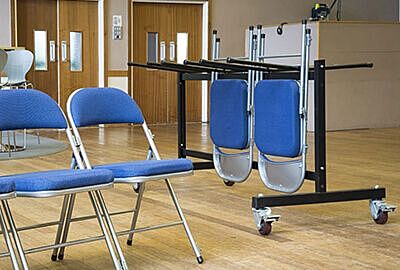
If you are still carrying chairs two by two across a hall, your back (and your floor) will eventually pay the price. High-quality furniture trolleys are the undisputed champions of efficient storage. Not only do they make the “moving” part faster, but many trolleys are designed to act as the storage unit itself.
Chair Bundles: Stacking chairs onto a trolley means they stay neat, mobile, and ready to be wheeled out at a moment’s notice.
Table Trucks: These allow you to store narrow tables vertically, turning a 10-foot floor space requirement into a 3-foot one.
Environment Matters (The UK Factor)
We all know the British weather. If you’re storing furniture in an external unit, a garage, or an unheated building, you have to account for moisture.
Airflow: Don’t push furniture tight against cold external walls. Leave a gap for air to circulate to prevent “sweating” and warping.
Pallets: If there’s any risk of dampness on the floor, keep your furniture (especially wooden items) off the ground using pallets.
Covers: Use breathable fabric covers rather than thick plastic sheets, which can trap moisture and cause wood to rot or metal to rust.
The “Last In, First Out” Rule
There is nothing more frustrating than realising the specific trestle tables you need for tomorrow’s seminar are buried behind fifty stacking chairs. When planning your layout, place the items you use most frequently nearest to the door. Create “aisles” if possible. If you have to move five things to get to one, your storage plan isn’t efficient, it’s a barricade.
Label Everything
It sounds simple, but a bit of masking tape and a marker pen go a long way. Label your trolleys or storage zones with the quantity and type of furniture. This saves you from having to unstack and recount every time you’re checking inventory for an upcoming booking.
Summary
Efficient storage is about three things: protection, access, and safety. By using the right transport tools and thinking about your layout before the heavy lifting begins, you’ll extend the life of your furniture and save yourself a massive headache down the line.
Prefer to have an AI Summary?
Chat GPT
Perplexity AI
Google Gemini AI


